
Much of today’s industrial software innovation is organised by discipline.
AI is entering mechanical CAD. Other solutions improve electrical engineering, PLC programming, robotics, simulation or documentation.
Each of these advances is useful. Yet they often address the same project from separate perspectives.
In a custom-built machine, the different disciplines work on the same machine, the same components and the same functions.
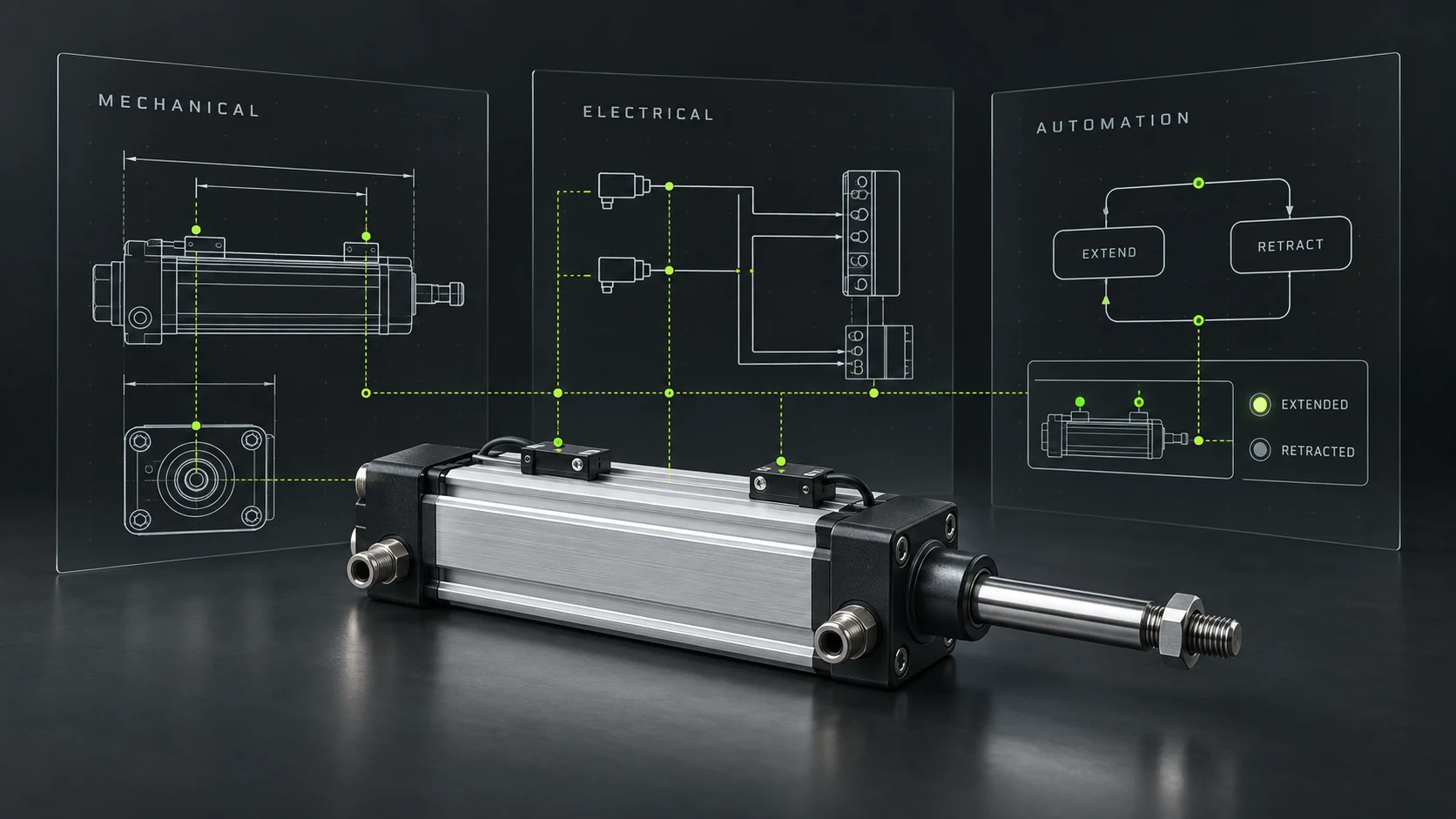
One cylinder. Several versions of the same knowledge.
Take a simple example: a pneumatic cylinder.
It first appears in the mechanical design. Its characteristics are already known: part reference, stroke, sensors, location in the machine and function.
Some of this information is then re-entered or reconstructed in electrical engineering to define its connections and inputs and outputs (I/O). It is used again in automation engineering to define its behaviour, then in the human-machine interface (HMI), alarms, documentation, simulation and sometimes, later, maintenance.
Speeding up each discipline with better tools addresses only part of the problem.
A broader role for industrial AI.
This also changes the potential role of AI.
Alongside generating PLC code or schematics more quickly, AI could help interpret, structure and retain the engineering reasoning that connects the different disciplines.
The value would extend beyond automating an individual task.
It would lie in using the same information or engineering decision several times, after defining it once.
The opportunity between disciplines.
For software developers and teams building industrial AI, we see a particularly interesting area to explore: the interfaces between engineering disciplines.
For industrial companies and automation integrators, the question could shift from:
“How can we automate more work within each engineering department?”
towards:
“How can we stop our engineering knowledge from being continually recreated as it moves from one discipline to another?”
This is precisely the kind of question FACTREN wants to explore with industrial technology developers and the people who use their tools in the field.
Where does engineering knowledge get lost in your workflow?
Whether you build industrial AI or use engineering software on real projects, bring us the handovers where information has to be reconstructed.
Explore the opportunity with FACTRENPerspective
An exploratory view of connected engineering, informed by industrial practice. The shared engineering layer described here is a direction to explore, not a FACTREN software product announcement.